
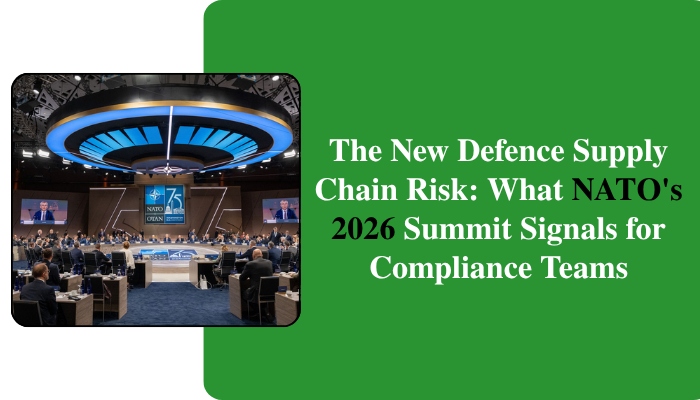
The defence industry supply base has been greatly enlarged by the recent July 2026 Ankara Summit of the North Atlantic Treaty Organization (NATO 2026). At this summit, the alliance agreed to procure over EUR 50 billion worth of defence equipment; this includes ten Airbus A330 MRTT tankers, nine Northrop Grumman Triton unmanned aerial vehicles, and joint procurement of twenty-five Saab GlobalEye early warning aircraft. Therefore, for compliance officers, there is an important consideration: with these numerous companies now involved in the various defence acquisition programmes, including the many tier-two or lower-level suppliers, how are they going to be screened?
President Alexander Stubb of Finland and Prime Minister Rob Jetten of the Netherlands were in attendance as part of the defence industry executive panellists at the forum’s plenary session titled “People, Plans and Products”, which was centred around industrial preparedness and defence production.
In addition to committing significant funding to acquire major weapons systems, NATO will implement two additional new industrial initiatives. It is the implementation of these initiatives rather than the amount of money committed that changes the nature of the task facing compliance officers, who will need to identify potential risks from all of the parties that will be involved in the defence procurement process.
Why Is NATO Deliberately Expanding Its Supplier Base?
Member states made major spending pledges at the 2025 summit in The Hague. Ankara was largely about turning those pledges into signed contracts and actual output after a year of defence industry groups pointing out the gap between commitment and delivery.
NATO answered with two platforms built for different jobs. The front door for industry simplifies how companies, including SMEs and startups, engage with NATO procurement, innovation programmes, and NATO’s first public unclassified demand signal. The Engine expands production capacity by connecting available factory capacity across the Alliance, fostering cross-border collaboration between European, Canadian, and US companies. Together, they point to a defence industrial base with more companies, more production relationships, and more cross-border suppliers than before.
More than 100 companies attended the Ankara Forum, sensing the industry participation NATO’s push to expand production and procurement is drawing.
Why Does a Bigger Supplier Base Mean More Screening Complexity?
A prime contractor delivering an aircraft or a drone programme brings in subcontractors for components, logistics, and specialised manufacturing. NATO’s procurement now spans aircraft, uncrewed systems, and infrastructure at once, so multiple programmes are recruiting suppliers at the same time.
A supplier reached through the Front Door may have little or no prior relationship with NATO because the platform exists specifically to bring in companies that haven’t worked with the Alliance before. That’s the expected result of opening access wider.
A new company entering a defence programme this way isn’t riskier than an established one by default. It’s less documented at a point when more companies are entering at once. That’s a volume problem and a documentation problem, separate from any individual supplier’s actual risk profile.
Also Read – 8 Best Sanctions Screening Providers in 2026 (Verified Sanctions, PEP, and Criminal Entity Data)
Where Does Screening Actually Get Difficult in a Defence Supply Chain?
Prime contractors are named in the press release. That visibility makes them the easiest part of the chain to screen.
The harder work sits in the tiers below them: the subcontractor a prime brings in to hit a delivery deadline, the joint venture formed to deliver a co-production commitment across two member states, and the logistics provider added midway through a contract. Ownership and control can materially change the sanctions risk associated with a subcontractor, even when the subcontractor itself has no direct sanctions match.
A global sanctions list search catches a direct name match on any of these companies. It can also surface adverse information about a facilitator through warrant and criminal entity records that wouldn’t appear in a sanctions-list search alone.
How Should Compliance Teams Screen New Defence Suppliers?
Seven steps turn that risk picture into something a team can actually apply, from the moment a new supplier enters a NATO-linked programme through the front door or a co-production deal:
- Start with the exact legal entity. Confirm the supplier’s legal name, jurisdiction, subsidiaries, and previous names before running any sanctions check.
- Don’t stop at the prime contractor. Ask which subcontractors, component suppliers, and logistics providers are actually delivering the contract.
- Trace ownership before clearing the supplier. Identify direct and indirect owners, the ultimate beneficial owner, and anyone with meaningful control rights.
- Screen every entity the ownership chain surfaces. Run sanctions checks on owners, controllers, and connected companies, not only the contracted supplier.
- Check more than sanctions lists. Review PEP and criminal entity information where the supplier, owner, or controller warrants extra scrutiny, since defence-adjacent joint ventures and government-linked partners can carry political exposure that a sanctions check alone won’t surface.
- Record when the ownership information was verified. A supplier cleared during onboarding may have a different ownership structure by the time the next contract is signed.
- Re-screen when the relationship changes. New owners, new joint venture partners, new jurisdictions, or new subcontractors should trigger another review.
Also Read – How to improve compliance with global sanctions screening
What NATO’s Supplier Expansion Means for Defence Supply Chain Screening in 2026
The addition in the NATO 2026 expansion does not introduce an additional sanction regulation for compliance teams to follow. Instead, it introduces scale: a bigger, more complex supply chain that must be identified, tracked, and cleared prior to being added as part of a defence contract, not after.
Türkiye is where this shift took place; Finland and the Netherlands are standing next to each other on stage. What changes for the compliance team behind any of these contracts is the size of the job: more entities to identify, more ownership chains to trace, and more sanctions, PEP, and criminal entity records to check before a supplier becomes part of the chain, not after.